 The Bite of the Honeybee: 2-Heptanone Secreted from Honeybee
Mandibles During a Bite Acts as a Local Anaesthetic in Insects and Mammals
The Bite of the Honeybee: 2-Heptanone Secreted from Honeybee
Mandibles During a Bite Acts as a Local Anaesthetic in Insects and Mammals
Honeybees secrete 2-heptanone (2-H) from their mandibular
glands when they bite. Researchers have identified several possible functions:
2-H could act as an alarm pheromone to recruit guards and soldiers, it could
act as a chemical marker, or it could have some other function. The actual role
of 2-H in honeybee behaviour remains unresolved.
In this study, we show that 2-H acts as an anaesthetic in
small arthropods, such as wax moth larva (WML) and Varroa mites, which are
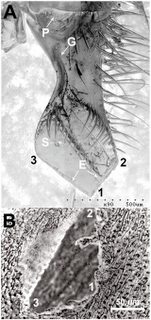
paralysed after a honeybee bite. We demonstrated that honeybee mandibles can
penetrate the cuticle of WML, introducing less than one nanolitre of 2-H into
the WML open circulatory system and causing instantaneous anaesthetization that
lasts for a few minutes. The first indication that 2-H acts as a local
anaesthetic was that its effect on larval response, inhibition and recovery is
very similar to that of lidocaine. We compared the inhibitory effects of 2-H
and lidocaine on voltage-gated sodium channels. Although both compounds blocked
the hNav1.6 and hNav1.2 channels, lidocaine was slightly more effective, 2.82
times, on hNav.6. In contrast, when the two compounds were tested using an ex vivo
preparation–the isolated rat sciatic nerve–the function of the two compounds
was so similar that we were able to definitively classify 2-H as a local
anaesthetic. Using the same method, we showed that 2-H has the fastest
inhibitory effect of all alkyl-ketones tested, including the isomers 3- and
4-heptanone. This suggests that natural selection may have favoured 2-H over
other, similar compounds because of the associated fitness advantages it
confers.
Our results reveal a previously unknown role of 2-H in
honeybee defensive behaviour and due to its minor neurotoxicity show potential
for developing a new local anaesthetic from a natural product, which could be
used in human and veterinary medicine.
 Lehnherr, Mathias (8. Aufl. 2017) [1992]: Imkerbuch